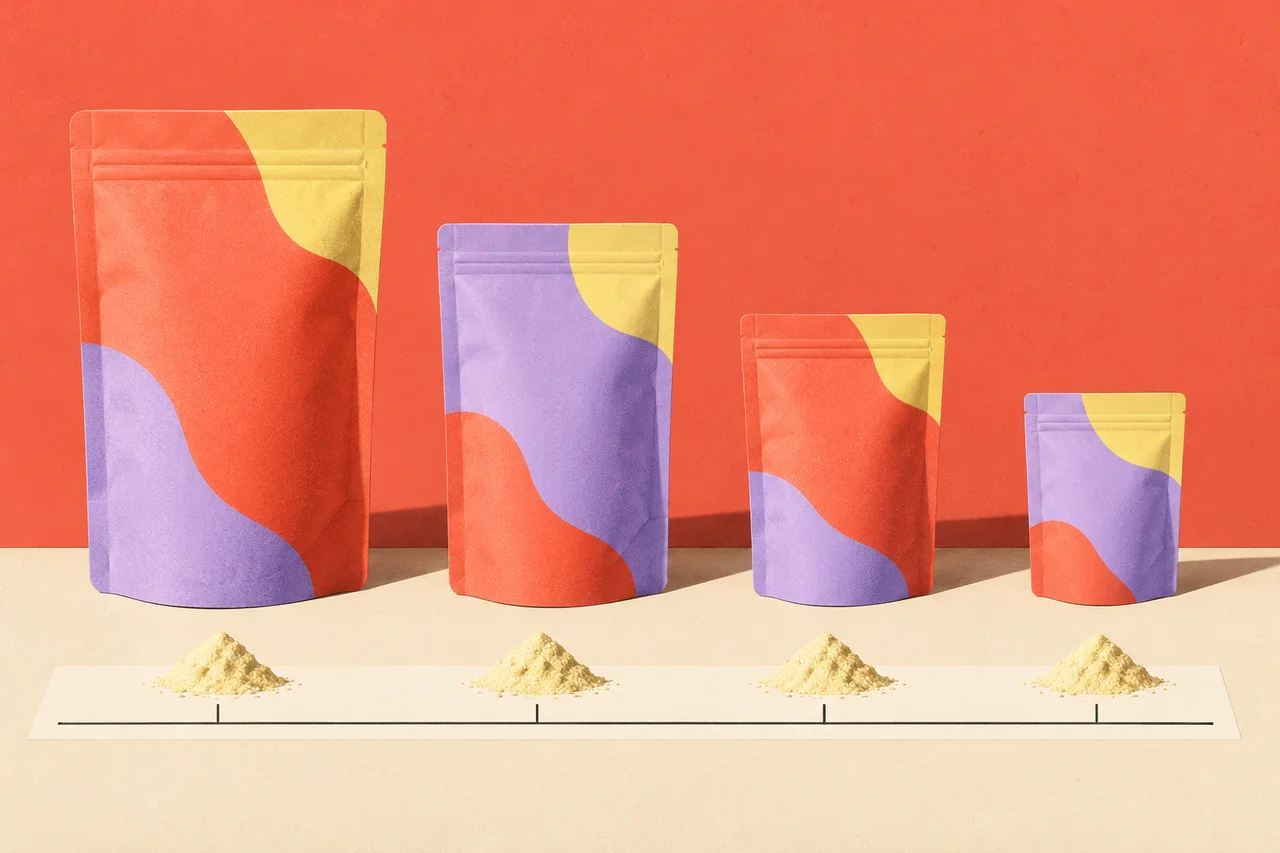
The smallest pack can have the lowest shelf price and the highest price for the amount it contains. The largest pack can cost more per gram than a medium one. A customer should be able to see both facts without opening a calculator or trusting a “best value” badge.
Unit pricing puts differently sized packs on a common basis. It does not decide how much someone should buy. A larger quantity may be cheaper per gram while exceeding their budget, storage space or likely use. Good price presentation keeps the total commitment visible beside the normalized comparison.
This guide uses fictional prices for four packs of the same dry product. It is a display and arithmetic exercise, not a survey of retailers or a statement of regional pricing requirements.
Use one base measure for the comparison
Shopify’s unit-pricing guidance calculates unit price by dividing the product price by the total quantity and multiplying by the chosen base measure. For a comparison per 100 grams, divide the price by the pack’s grams, then multiply by 100.
Here is the fictional range. All prices exclude shipping and tax, and every pack contains the same product at the same concentration and quality.
| Pack | Quantity purchased | Pack price | Price per 100 g |
|---|---|---|---|
| Small | 250 g | $4.80 | $1.92 |
| Medium | 400 g | $7.20 | $1.80 |
| Large | 750 g | $12.90 | $1.72 |
| Twin pack | 2 × 500 g, 1,000 g total | $18.00 | $1.80 |
The large pack has the lowest unit price in this example. The twin pack contains the most product, but its unit price equals the medium pack’s. The small pack requires the least money today. Each statement is true, and each may matter to a different customer.
Use the same base measure throughout the comparison. Mixing a price per gram on one card with a price per kilogram on another turns an apparently helpful feature into another conversion exercise. Choose a measure that produces a readable number for the category, then keep it consistent across the relevant pack choices.
Keep the quantity behind the number visible
A unit price needs a denominator. “$1.72” without “per 100 g” looks like a possible selling price. “$1.72 per unit” is still ambiguous if the page also calls a bag or case a unit.
Show a compact pair such as “$12.90 for 750 g” and “$1.72 per 100 g.” The first line describes the purchase; the second supports comparison. Neither should depend on a tooltip that disappears when the customer tries to inspect another pack.
For a multipack, show both the component size and total quantity. “2 × 500 g” helps someone understand the physical packaging, while “1,000 g total” makes the calculation transparent. Do not divide by the number of outer packs when the comparison is intended to describe the amount of product inside.
The underlying data should preserve those distinctions too. Shopify’s unit price measurement object separates the quantity value and its unit from the reference value and reference unit. Whatever platform the store uses, an editor should be able to identify those inputs before trusting the displayed result.
Round the display after calculating
Calculate from the actual price and quantity, then round the displayed unit price consistently. In the illustrative range, $12.90 divided by 750 grams and multiplied by 100 gives $1.72 per 100 grams. The pack price remains $12.90; the normalized figure is an aid to comparison.
Avoid calculating a new total by multiplying a rounded unit price back up to the pack size. With other prices and weights, rounding can make that reconstructed amount differ from the actual charge. The checkout total should come from the price of the item being sold.
Decide how much precision is useful. A category with very low cost per gram may need a larger base measure to avoid displaying every option as a few rounded cents. More decimal places are not automatically clearer. The display should reveal a meaningful difference without pretending the customer can purchase the product at that tiny increment.
Keep currency formatting consistent as well. A product price and its unit price should refer to the same selected currency and offer. If the store supports several markets, verify the visible result in each supported pricing setup instead of assuming a changed currency symbol is sufficient.
Do not confuse a cheap unit with a suitable order
Suppose a buyer needs roughly 800 grams of the fictional product. Two medium packs provide 800 grams for $14.40, while the twin pack provides 1,000 grams for $18.00. Both have a $1.80 price per 100 grams. The twin pack does not offer a unit saving in this example; it simply contains more product.
The large pack has a lower unit price but provides 750 grams, which may be insufficient for the intended use. Whether buying an additional pack makes sense depends on the actual need. The display should help the customer see that tradeoff without steering them through a misleading economy claim.
A “lowest unit price” label is more precise than an unqualified “best value” label when the comparison supports only the arithmetic. If the badge depends on an offer, membership or subscription, state that condition. A one-time purchase and a recurring commitment are different commercial choices even when their normalized prices can be calculated the same way.
Keep these examples focused on comparable goods. Equal mass does not establish equal strength, yield, quality or suitability. Concentrated cleaners, prepared foods and products sold by usable coverage may require a different comparison. Explain the relevant measure rather than normalizing unlike products into a falsely neat ranking.
Recalculate when the selected offer changes
A pack selector should update quantity, pack price and unit price together. If the title says 750 grams while the unit price still belongs to the 250-gram option, the page has become internally inconsistent.
Review the same interaction for temporary offers and multipack choices. When a promotion requires buying more than one item, describe the quantity required to obtain the advertised price. A customer selecting one pack should not see the promotional unit price as if it were already available.
Some discounts are only determined later in the cart. If the product page cannot reliably calculate the customer’s final offer, keep its comparison clearly tied to the displayed product price. Do not include a guessed discount in the unit-price calculation. The cart can show the confirmed savings once eligibility is known.
Check the comparison from the buyer’s side
Choose one pack and reproduce its unit price from the visible information. Then change pack size and repeat. This simple check catches missing quantities, stale values and multipacks calculated from a single component rather than the total.
Inspect the collection card, product page and cart together. The same product should not use three different base measures without a good reason. At narrow widths, the measure should remain attached to the amount rather than wrapping into an unrelated line beneath another price.
Finally, ask what the customer can conclude. They should know the amount charged for the selected pack, how much product arrives and how that price compares on the common measure. The broader pricing-page guidance is about making choices understandable. Unit pricing does its part when the customer can compare fairly while still seeing the size of the purchase they are about to make.